Clients do not renew a service they cannot see. They renew work that is shown to them, in plain words, on a fixed date, month after month. That is why white label seo reporting is important. A good report proves the retainer bought real work, shows what changed, and tells the client what comes next. A weak report, or no report at all, leaves the client guessing, and guessing clients leave.
Quick answer: A monthly report keeps a client when it shows three things: results in plain numbers, work done in plain words, and next steps with dates. Put your logo on it, send it on the same date each month, and keep it short enough to read in five minutes.
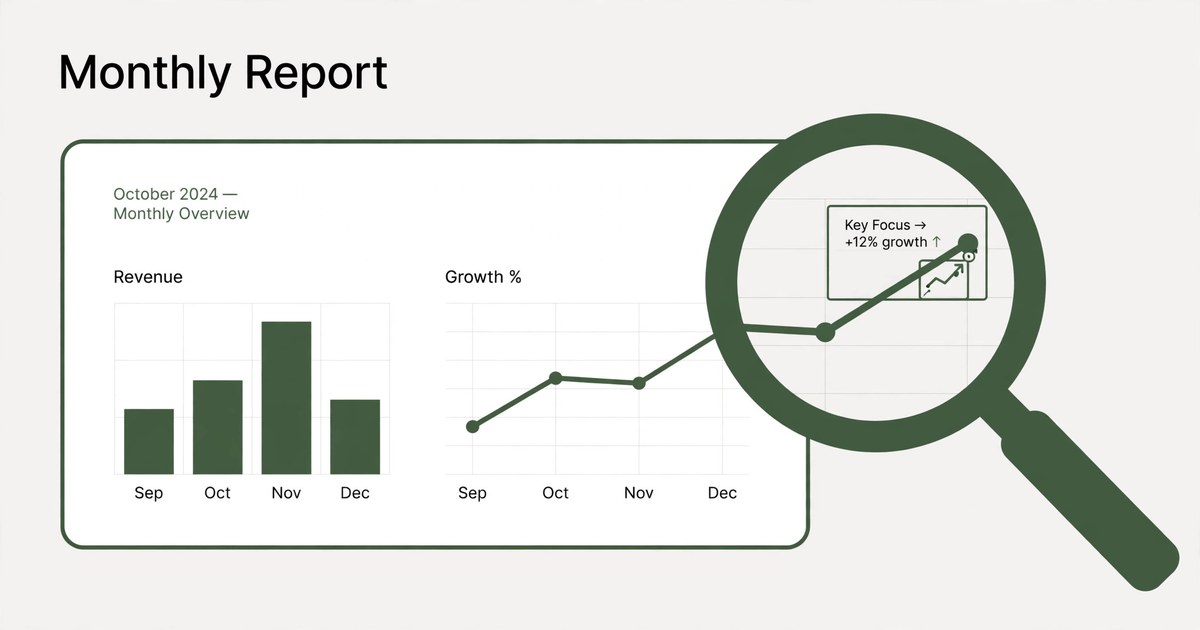
Why white label seo reporting is important to clients
An agency client pays every month for work that happens out of sight. Pages are fixed, content is written, links are earned, and listings are cleaned. None of that is visible unless the report shows it. Without a report, the client judges the service by one feeling: "Do I feel busier?" Feelings change with one slow week. A report gives the client facts to judge by instead.
Reporting also protects the agency. When a client asks what the retainer bought, the report answers before the question becomes a complaint. When results dip for a month, the report shows the work that continued through the dip. When a client is happy, the report gives them a document they can show a partner or a boss. That document is often what renews the contract.
White label reporting adds one more layer. The report carries the agency logo, not the provider name. The client sees one brand, one contact, and one story about their account. That matters because the client hired the agency, not a hidden team. Read the white label seo reports page for what a branded report looks like and what it covers each month.
What clients actually read first
Clients read reports from the top, and they stop early. Put the result first, not the activity list. A client who sees "calls up, bookings up" in the first lines will read on. A client who sees a list of 40 tasks with no result beside them will close the report and remember only that it was long.
The order that works is simple. First, the result: rankings, traffic, calls, or bookings, in plain numbers with a comparison to last month. Second, the work: what was done, in short lines a non technical reader can follow. Third, the next steps: what happens next month, and what the client needs to approve, if anything. Anything that does not fit those three parts belongs in an appendix or not at all.
Keep the language plain. Write "fixed 12 broken links" instead of a technical error name. Write "published 4 service pages" instead of a content count with no context. Write "ranking for the main service term moved from position 8 to position 5" instead of a chart with no labels. Plain words are not dumbing down. They are the reason the client reads to the end.
The three parts of a report that keeps clients
| Part | What it shows | What to avoid |
|---|---|---|
| Results | Rankings, traffic, calls, bookings, with last month beside them | Charts with no labels or no comparison |
| Work done | Pages, content, fixes, links, in short plain lines | Long task lists with no result beside them |
| Next steps | Next month plan, and anything the client must approve | Vague promises with no dates |
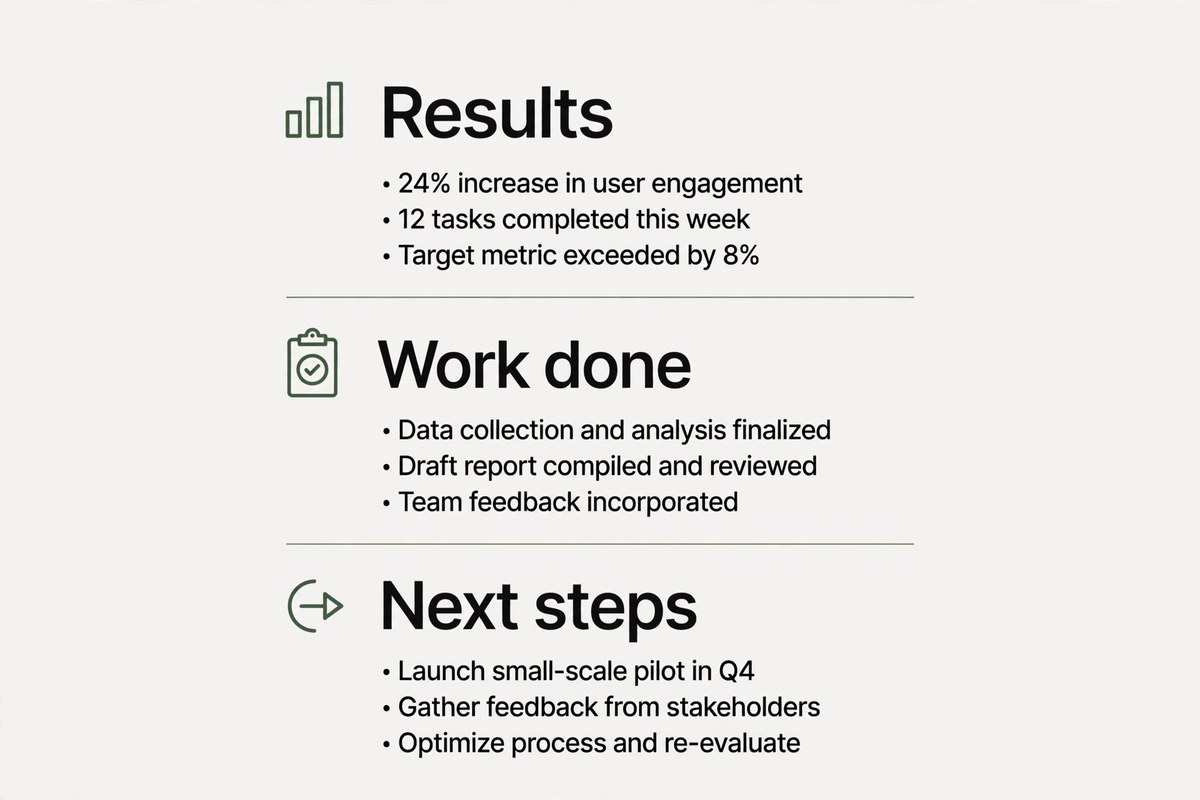
Each part has one job. Results prove value. Work done proves effort. Next steps prove the plan continues. If a report has results but no work, the client wonders what they paid for. If it has work but no results, the client wonders whether the work matters. If it has neither next steps nor dates, the client wonders whether anyone is steering the account.
A sample scorecard, in plain numbers
A scorecard is the first page of a good report. It holds four numbers a client can read in one minute: rankings, traffic, leads, and tasks done. Each number sits beside last month, so the client sees direction at a glance. The scorecard below is a sample layout, not a client result. Its numbers show the shape of the page, not a promise.
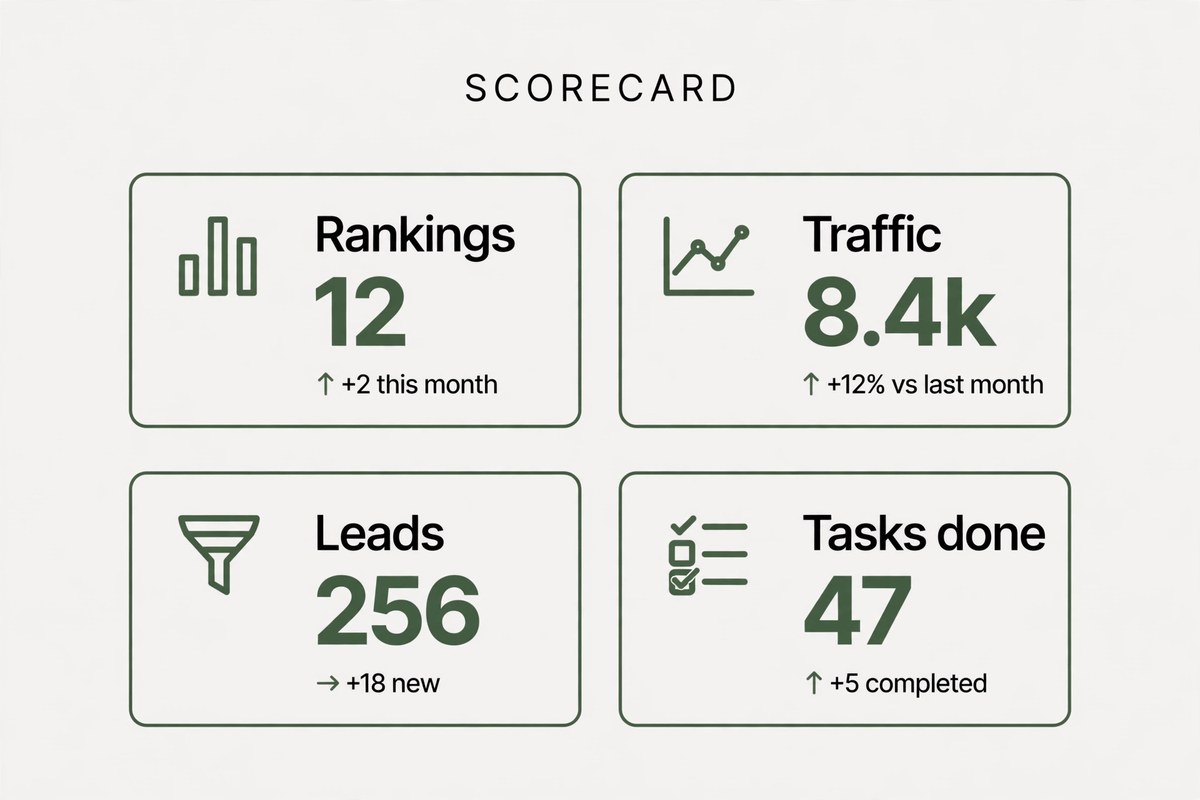
Pick metrics the client cares about, not metrics that flatter the report. A contractor cares about calls and bookings. A clinic cares about appointment requests. A B2B firm cares about qualified leads. Rankings and traffic support those numbers. They do not replace them. If a report shows traffic up and calls flat, say so, and say what changes next month to fix it. Honesty in a bad month keeps more clients than a polished report that hides it.
The report date rule
Send the report on the same date every month. At WhiteLabelSEO, the monthly branded report is delivered on the 3rd of every month. That fixed date does quiet work. The client learns when to expect it. The agency learns when to prepare questions. No one chases it, and no one wonders whether work happened.
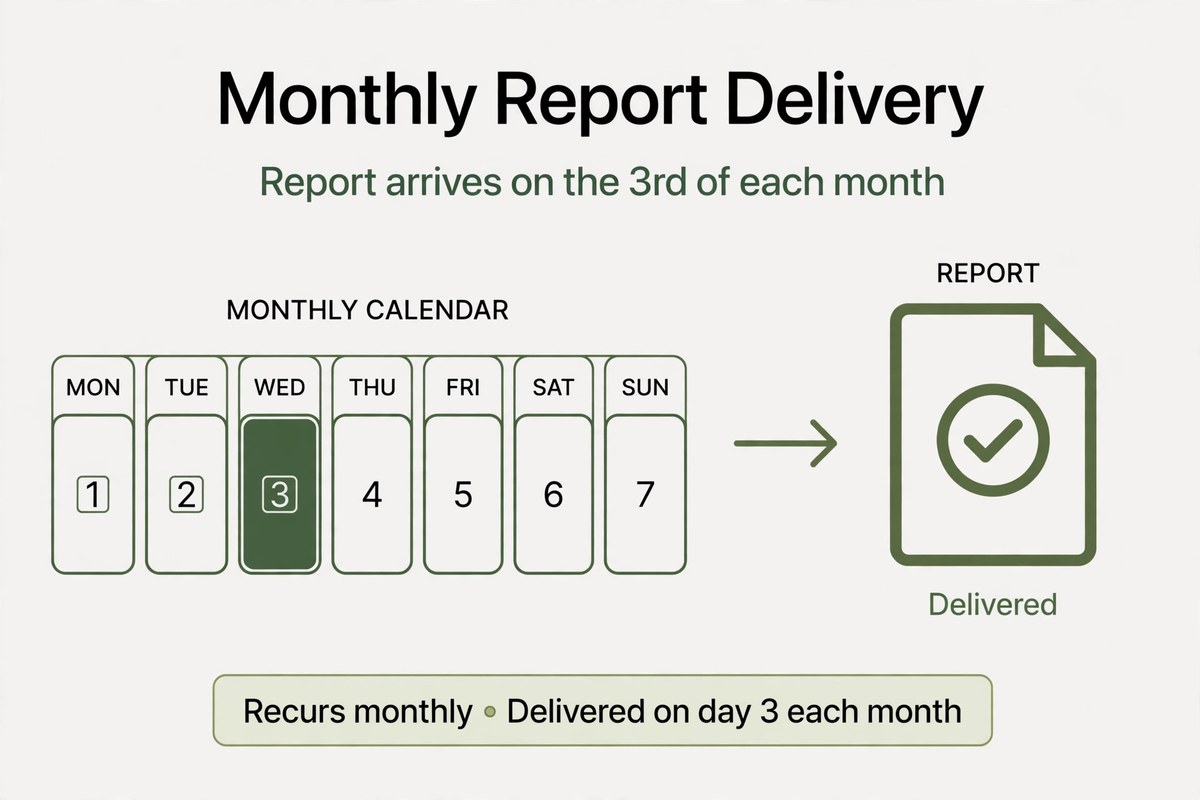
A late report costs more than a late task. A task can be fixed in a week. A late report tells the client the agency is disorganized, even when the work was done on time. A missed deliverable means that month is not charged at WhiteLabelSEO, which is the right rule, but the goal is never to use it. Set the date, keep the date, and tell the client the date in the first report so they can hold you to it.
Revisions are included, and one named account lead answers questions about the report. A client who does not understand a number should be able to ask one person and get a plain answer within 4 business hours. That reply matters as much as the report itself, because it turns a document into a conversation.
What bad reporting costs
Bad reporting costs clients in three ways. First, it creates questions that a good report would have answered. Each question is a small doubt. Doubts stack up into a cancellation call. Second, it hides problems until they are large. A ranking drop caught in month one is a fix. A ranking drop found in month four is a lost client. Third, it makes the agency look like a cost, not a service. A client who cannot see work will cut it first when budgets tighten.
Watch for these warning signs in your own reports. The report arrives on a different date each month. The report has no comparison to last month. The report lists tasks but no results. The report uses terms the client has never heard. The report has another brand on it. Fix any one of these and the report improves. Fix all five and the report becomes a retention tool. That is why white label seo reporting is important for renewals: the report is the proof the client sees each month.
Read the seo white label rank checking guide for how rank data feeds the report, and the white label seo analysis tool guide for how scans turn into report content. Both feed the same monthly document your client reads.
Who this fits, and who it does not
Branded monthly reporting fits any agency with monthly SEO, local SEO, or GBP clients. It fits agencies that sell on retainers and need renewals. It fits agencies whose clients are small business owners who judge value by calls, bookings, and plain numbers.
It does not fit a one time project with no monthly work, since there is nothing to report each month. It does not fit a client who refuses to read any report and only wants a phone call, though even that client benefits from a one page scorecard beside the call. In that case, send the scorecard and keep the call. The document still protects the agency when the client later asks what was done.
For the tools behind the numbers, see Search Console help and Google Analytics help. Both are free sources your team can use to check the same numbers the report shows.
Our terms stay simple: month to month, 30 days notice to cancel, no setup fees, no annual contract, one named account lead, and a signed NDA before client data is shared. See our signed NDA page for the exact terms. White label seo services for agencies cover the monthly work, and white label seo pricing lists every tier in plain numbers.
Write the report your client can read in five minutes, send it on the 3rd, and answer questions within 4 business hours. Then book a 30 minute call to see a sample branded report for your agency.
Frequently asked questions
Why is white label seo reporting important?
White label seo reporting is important because clients renew work they can see. A monthly report shows results, work done, and next steps under the agency brand. Without it, the client judges the service by feeling, and feelings change with one slow week. With it, the client judges by facts, and facts renew contracts. Reporting turns hidden monthly work into proof the client can read and share.
What should a white label seo report include?
A good report includes three parts: results in plain numbers with last month beside them, work done in short plain lines, and next steps with dates. Add a one page scorecard at the top with rankings, traffic, leads, and tasks done. Leave out long task lists with no results, charts with no labels, and terms the client has never heard. Keep the report short enough to read in five minutes.
How often should agency clients get a report?
Monthly is the right rhythm for most agency clients. Weekly reports create noise and hide the trend. Quarterly reports arrive too late to catch problems. A monthly report on a fixed date, the 3rd at WhiteLabelSEO, gives the client a steady habit and the agency a steady deadline. Send a short note between reports only when something needs the client decision or approval.
What if a report shows a bad month?
Say so plainly, and say what changes next month. Show the result, the work that continued, and the fix. Clients accept bad months when they understand them. They leave when bad months are hidden and found later. A report that shows a dip with a plan keeps more trust than a polished report that pretends every month rises. Honesty in the report is a retention tool.
Do clients actually read monthly reports?
Clients read reports that are short, plain, and on time. They skip reports that are long, technical, or late. Put the result first, keep the scorecard to one page, and use plain words for every task. A client who reads only the scorecard still learned the result, the direction, and the next step. That is enough. The full report exists for the client who wants detail.
Should the report carry my agency brand?
Yes. The client hired your agency, so the report should carry your logo and your name, not the provider name. White label reporting means the provider stays invisible and the agency owns the client relationship. Check that branding is included in your plan before you buy, since some tools charge extra for it. A report with another brand on it undermines the agency in front of its own client.
The report is only as honest as the audit behind it, so read the free white label seo audit tool guide for what a free audit covers, what it leaves out, and how to turn its findings into the paid plan your report then tracks.