
B2B seo strategy content marketing is the plan that turns topics into pipeline for business clients. It maps each page to one buyer job, then ties that page to a lead, a qualified lead, and a deal. Without that map, content piles up and pipeline stays flat.
This post is for agency owners who serve B2B clients and need content that sells the client case, not just fills a blog. You will get a topic map, a page type table, a step process, a sample brief, and a margin example built on posted prices. The parent guide on b2b seo strategy for agencies sets the wider plan this content sits inside.
Quick answer: start with buyer jobs, build one page per job, link each page to the next step, and report on pipeline stages instead of visits alone.
Start with buyer jobs, not a topic list
A B2B purchase has a group behind it. One person feels the problem. Another checks the budget. A third checks risk. Each person searches in different words, and each one needs a different page. A topic list that ignores the group will rank for the wrong readers.
Write down the group for one client first. Name who uses the product, who signs the order, and who can block it. Then list the questions each person asks at each stage: problem, comparison, and vendor choice. Those questions are your topics. Any topic that matches no question gets cut, no matter how much volume it shows.
That cut is the strategy. Most B2B blogs fail from too many topics, not too few. A tight set of pages that each serve one buyer job will beat a wide blog that serves none well.
B2B seo strategy content marketing by page type

B2b content marketing and seo work best as a small set of page types, each with one job. Build the set for one client before you add volume.
| Page type | Buyer stage | Next step on the page |
|---|---|---|
| Problem guide | Problem | Read the comparison page |
| Comparison page | Comparison | View product or pricing pages |
| Product and integration page | Vendor choice | Book a demo or call |
| Help and pricing page | Vendor choice | Book a demo or call |
| Case style proof page | Comparison and vendor choice | Read a related guide or book a call |
Proof pages need care. Use only real, cited, permissioned data for case claims and statistics. A proof page with invented numbers will hurt the client more than no proof page at all. When proof is thin, write the comparison honestly and let the product pages carry the detail.
Link the set in order. Problem guides link to comparisons. Comparisons link to product pages. Product pages link to pricing and help pages. That chain moves a reader forward. A page with no next link is a dead end, and dead ends do not make pipeline.
A topic to pipeline process with timings
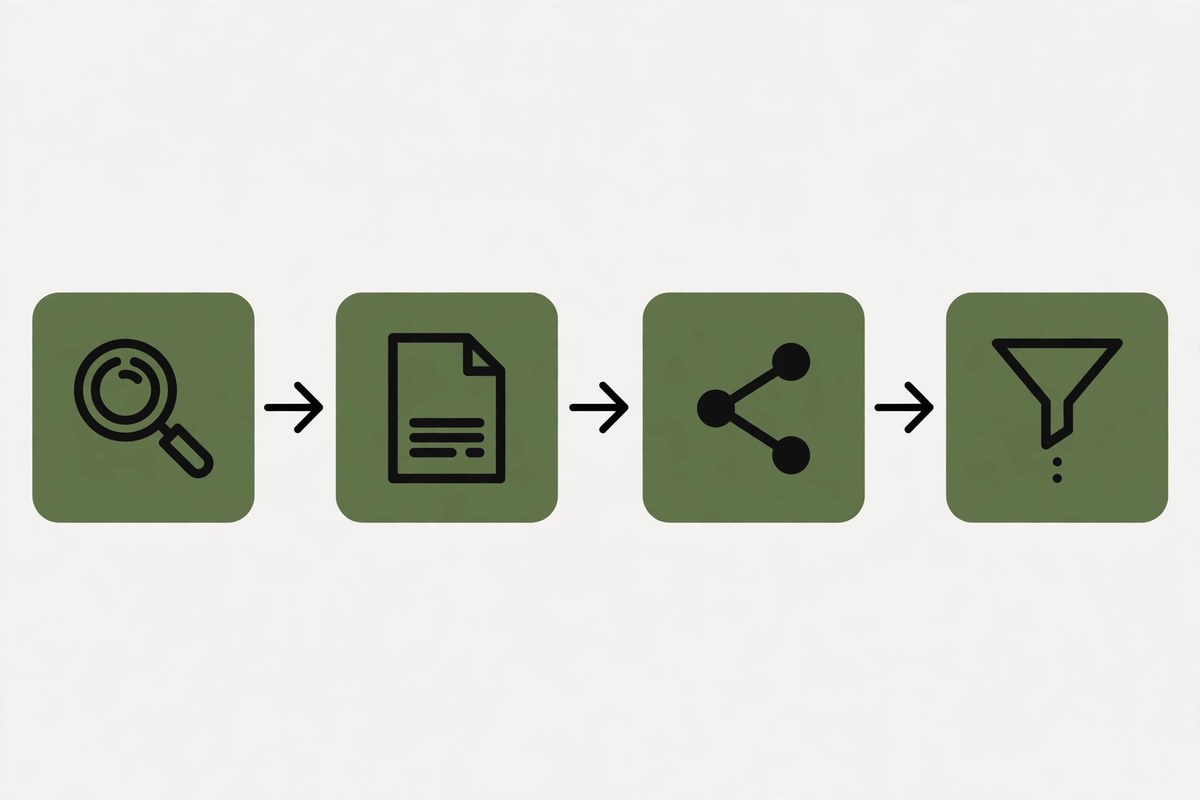
Run content as a process with dates, not as a pile of drafts. This b2b seo strategy content marketing process gives each page a job, a date, and a report line. Our delivery facts set the pace for the agency side: jobs start within 48 hours of the brief, one named account lead owns each partner account, and the response commitment is 4 business hours. Use the same pace for content jobs.
- Week 1, research: map the buying group and list the questions per stage. Cut any topic that matches no buyer question.
- Week 1 to 2, brief: write one brief per page with the buyer job, the target term, the next step, and the proof allowed. No brief, no draft.
- Week 2 to 4, build: draft, edit for plain words, add internal links in chain order, and check titles, headings, and schema. Start each job within 48 hours of its brief.
- Week 4, report: send the branded monthly report on the 3rd where the month closes, and show leads and qualified leads per page, not visits alone.
- Each month after: refresh the pages that draw buyers, drop the pages that draw only students and job seekers, and add one new buyer question per theme.
That cadence keeps content tied to pipeline. When a page draws visits and no leads, the fix is usually the next step on the page, or the wrong buyer job. Fix the page before you write a new one.
Sample content brief you can copy
A brief stops drift. A b2b seo content strategy lives or dies on its briefs, so copy these fields into every content job, and fill each one before drafting starts.
- Buyer job: one sentence on who reads this page and what they need to decide.
- Target term: one primary phrase, plus one or two secondary phrases that read naturally.
- Page type: problem guide, comparison, product page, help page, or proof page.
- Next step: the one link or action the reader should take after reading.
- Proof allowed: real data only, with source and permission where needed. Leave blank rather than invent.
- Internal links: parent page, one related guide, and the next page in the chain.
- Questions to answer: three to five questions from buyers, in their words.
- What not to claim: no ranking promises, no timelines, no invented statistics.
Keep briefs short. A brief longer than the page helps no one. One page of brief per page of content is plenty, and a short brief gets read while a long one gets skipped. For the technical baseline under the content, use the Google SEO starter guide and Search Console help.
Copyable checklist for each content month
Run this b2b seo strategy content marketing checklist for each B2B client, each month, and keep the filled copy with the monthly report.
- Buying group mapped, with one page per buyer job.
- Every new page has a brief, a target term, and a next step.
- Problem guides link to comparisons, comparisons link to product pages.
- Titles name the page topic plainly, with one H1 per page.
- Schema added where it fits the page type, such as Article or FAQPage.
- Technical blocks checked first: crawl blocks, broken links, and slow buyer pages.
- Old pages refreshed instead of duplicated on the same topic.
- Report shows leads and qualified leads per page, not visits alone.
- Proof claims checked for source and permission before publishing.
- Dead topics cut, and one new buyer question added per theme.
What the margin looks like on a Growth plan
Content work pays when it sits inside a retainer with a clear margin. A Growth plan costs $1,500 per month and the typical agency resale is $3,200 per month. That leaves $1,700 per month per client before your own time.
Five clients on that math: cost $7,500 per month, resale $16,000 per month, margin $8,500 per month. Content hours eat that margin fast when briefs are vague, since each rewrite costs a draft cycle. A tight brief and a fixed monthly page count protect the margin better than any tool.
Do not sell content by volume alone. Sell a set of pages tied to buyer jobs, with a report that shows pipeline stages. That framing holds up in renewal talks, while a volume promise falls apart at the first flat month. See the posted pricing for white label seo before you set the resale price for a content retainer.
Who this is for and who this is not for
This strategy fits an agency that serves B2B clients with long sales cycles and a buying group, such as software, manufacturing, and services firms. It fits teams that can hold a monthly cadence and report on pipeline stages. For the report side, read why white label seo reporting is important to see what clients actually read.
It does not fit a client who wants fast volume with no buyer map, or a client who will not share lead and deal data. Without lead data, content can only report visits, and visits alone will not hold a retainer. It also does not fit a site with technical blocks that stop pages from ranking at all. Fix those blocks first, with help from our guide to white label seo audit tools, then build content on a sound base.
For the wider service behind the content, read white label seo services for agencies to see what delivery covers and how content fits inside it.
Frequently asked questions
How long does B2B content take to reach pipeline?
There is no fixed timeline, and no honest provider promises one. What you can plan is the work cadence: research and briefs in week 1, drafts in weeks 2 to 4, and pipeline reporting each month after. Judge a page by leads and qualified leads over months, not by visits in week 1.
How many pages should a B2B client publish each month?
Fewer than most agencies sell. One to three strong pages per month, each tied to a buyer job, beats ten thin pages that match no question. Add volume only after the first set shows leads, and keep the brief rule: no brief, no draft.
Who writes the content in a white label setup?
The provider team drafts under your brand, from briefs tied to buyer jobs, and the agency owns the client relationship and the strategy talks. Revisions are included, and one named account lead owns each partner account, so feedback goes to one person.
How do you measure B2B content if traffic stays flat?
Measure pipeline stages per page: leads, qualified leads, and deals the client ties back to search. A page with low visits and real leads beats a page with high visits and none. Report those stages in the monthly report, beside the work done and work next.
What if the client has no content team of their own?
That is the normal case for an agency client. The agency owns the brief and the client review, while delivery sits with the provider team. Keep client review to one round per page with clear notes, so drafts do not stall on vague feedback.
Start with one buying group and one theme, and build the chain from problem to product page. Book a 30 minute call to talk through the content plan for one B2B client, or start from the parent strategy guide and map the first theme this week.